Dr. Gabriel Henderson, Aarhus University
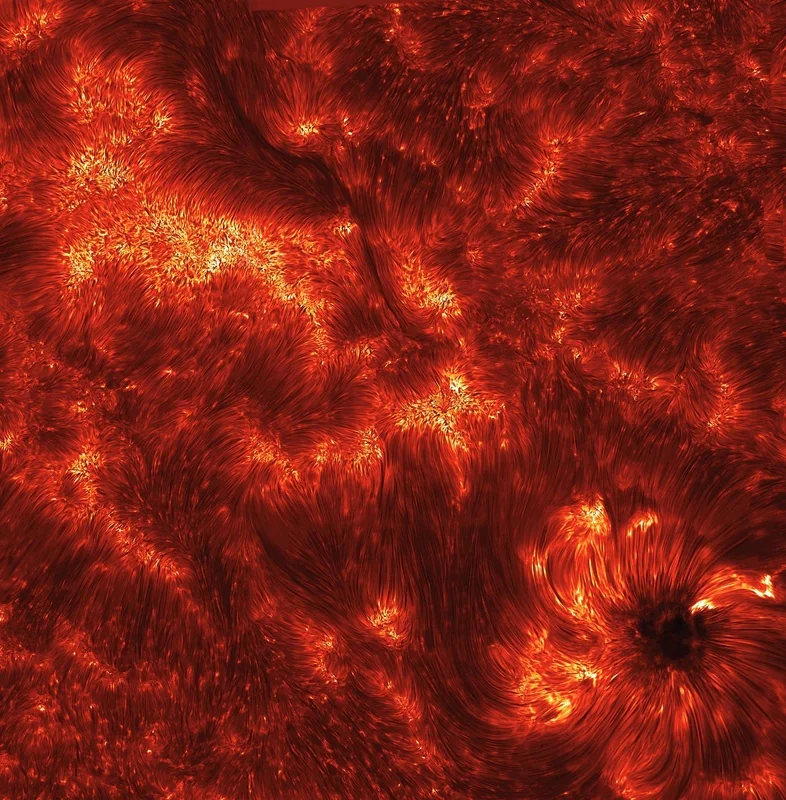
Counting in everyday life is a relatively straightforward affair; one, two, three, and on and on. Less simple is the process of reliably counting the number of sunspots on the surface of the sun. Sunspots are darkened areas on the solar surface. In Europe, people knew of their existence at least since the early 17th century, and some of the larger sunspots were probably noted long before Galileo. Elsewhere, sunspot counts were maintained for much longer. Counting these darkened areas is one of the most effective ways to establish a record of the evolution in solar behavior. Not only do sunspot observations provide crucial information about changes in the sun’s magnetic field, they strongly correlate with long-term fluctuations in the amount of energy released by the sun – the so-called solar cycle.
Yet, in the 1970s, counting sunspots signified something much more dramatic and nefarious about the history of science itself. In these years, John “Jack” Eddy, an astrophysicist with the National Center for Atmospheric Research, began to scour old, dusty books in library basements to resuscitate a long-forgotten event in the history of solar behavior, behavior that seemed completely at odds with the prevailing orthodox understanding of the sun. Despite what appeared to be the historic and predictable vacillation in the number of sunspots every eleven years, a regularity known to exist since the mid-19th century, Eddy noticed in his records what appeared to be the virtual absence of sunspots between 1645 and 1715.
This curious blemish in the solar record was no small discovery. “If it really happened,” Eddy noted in one of his earliest talks on the matter, “we should recognize it as perhaps the most drastic thing that has ever happened to the sun since we began observing it and start including it in our work on the solar cycle." (Eddy, 1974) The implication was obvious: if the sun acted regularly and predictably every eleven years or so, how does one explain the disappearance of sunspots for almost a century?
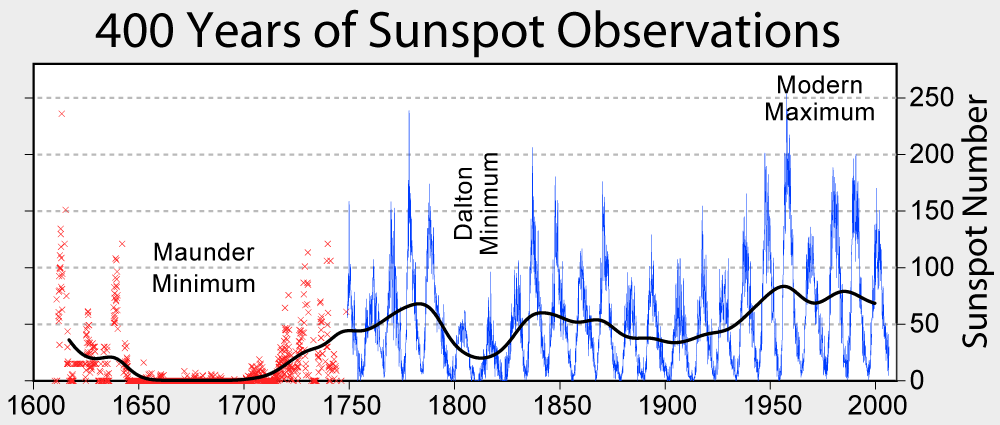
The lack of sunspots was not Eddy’s discovery, at least not in the purest sense. What he called the Maunder Minimum had been observed almost a century earlier by British astronomer Edward Walter Maunder, who began to publish his findings during the 1890s. To Eddy’s consternation, however, Maunder’s discovery appeared to have been forgotten by the astrophysics community. How could this be? Scientific observations and facts don’t just disappear, do they? To Eddy, the answer was yes. A cursory glance at the matter yielded at least one possible reason why: Maunder was not vocal enough about his discovery. But further research yielded a much richer narrative, one that compelled Eddy to examine the deeply held assumptions of his own profession.
Eddy’s investigation, as it turned out, showed that Maunder was not forgotten merely because of his inability to properly disseminate his finding about sunspots, but rather because the astrophysical community had – for almost a century – allowed their preexisting assumptions to blind them to new ideas. A conspiracy had taken place, Eddy argued, one based in what appeared to be a universal belief that the sun acted regularly and predictably according to the solar cycle – what he called the principle of solar uniformitarianism.
The strength of Maunder’s observations was insufficient to break the universally-accepted canon of solar regularity. Instead of acknowledging and understanding an anomaly in solar behavior, “solar physicists have largely continued to ignore or forget the anomaly, if real,” Eddy insisted in the spring of 1976. “Some have institutionalized the solar cycle and made a profession of extending it into the past and predicting in the future; ignoring, doubting, or intentionally diluting the claims of Maunder of this skeleton in the closet of solar physics." (Eddy, 1976)

This was a dramatic claim, but one that became inextricably interwoven with Eddy’s public admonishment – if not condemnation – of professional orthodoxy within science itself. Eddy wrote about the topic, gave interviews, and addressed scientific and popular audiences – all in the hope that his tempest of activity would lead to Maunder’s long-overdue recognition. But perhaps more poignantly, Eddy portrayed himself as the detective who pulled back the curtain to reveal the biases and prejudices that prevented what he considered to be genuine scientific progress. For him, contemporary astrophysics was a stale and unstable artifice, and only through the work of pioneers like himself – and the forgotten Maunder – could one dispel the fashionable tropes that dictated popular understanding of scientific progress. As he described to an audience within the Boston Museum of Science in May 1978, “In fact, much of what we know, or think we know is not that way at all. And if we have the heart and stomach to look down at it closely, is based upon a shaky and often overextended framework of assumptions – cantilevered scaffolds of bamboo poles and weathered twine.” (Eddy, 1978)
This is an important story in part because it helps to explain why Eddy spoke about sunspots with what historian Kark Hufbauer referred to as “a missionary’s zeal.” (Hufbauer, 1991) But what else does the story show? It certainly does not mean that Eddy’s pioneering work led to a wholesale abandonment of the idea that the sun (for the most part) behaves in a regular, cyclical fashion. That interpretation would be too extreme. However, it would not be too extreme to argue that he used what he considered a crime against Maunder to justify his own predilections as a scientist. Throughout his professional life, he harbored a deep skepticism toward what he saw as scientists’ proclivity for unoriginality and challenged others’ apparent unwillingness to probe the very depths of their own professional, and sometimes erroneous, assumptions. Eddy was comfortable opening the closet.
~Gabriel Henderson
Sources:
Eddy, John, "The Long Solar Winter," 1974 December 5, Box 2, John Eddy Papers, National Center for Atmospheric Research.
Eddy, John, ”Maunder Minimum,” 15 April 1976, Box 3, JEP
Eddy, John, ”The Changing Sun,” 28 May 1978, Box 3, JEP
Hufbauer, Karl. Exploring the Sun: Solar Science Since Galileo. Baltimore: Johns Hopkins University Press, 1991.